Counting Down Elvis by Mark Duffett
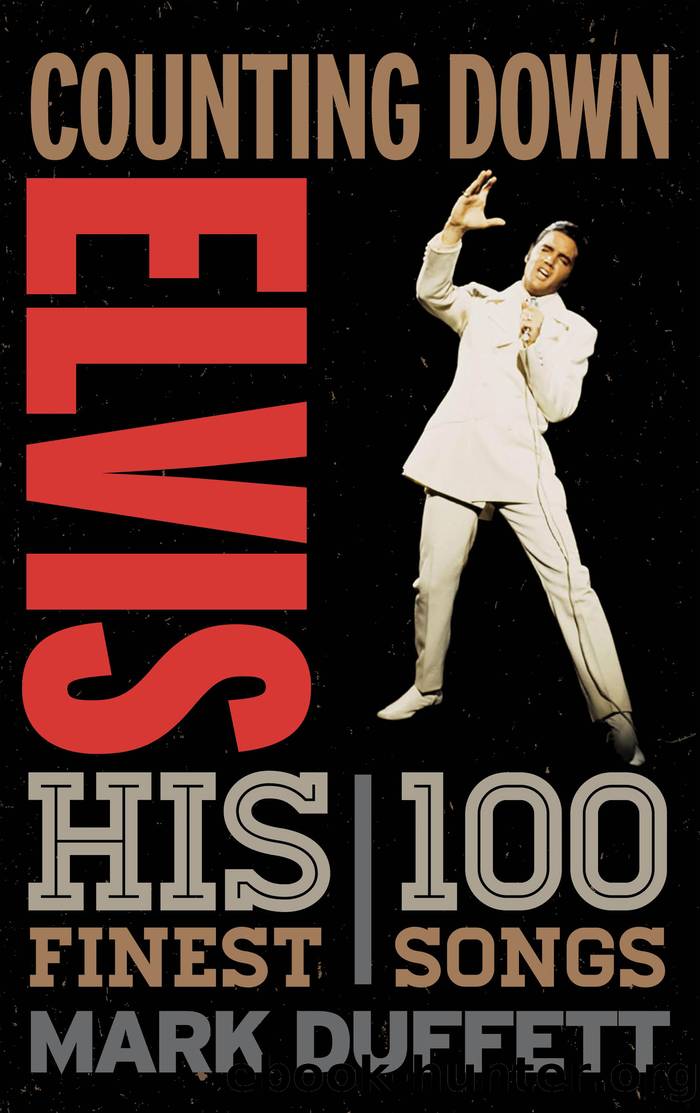
Author:Mark Duffett [Duffett, Mark]
Language: eng
Format: epub
Tags: undefined
Publisher: Rowman & Littlefield Publishers
Published: 2012-05-15T00:00:00+00:00
Fooling around after he’d been taught a guitar lick by his friend Freddy Weller—who played with Paul Revere & the Raiders—Davis developed a song around the theme of racism and social injustice. “Dying is a metaphor,” he explained, “for being born into failure. Being born into a situation where you have no hope.”[337]
“In the Ghetto”’s initial subtitle, “The Vicious Circle,” referred to anthropologist Oscar Lewis’s “culture of poverty” argument. At the University of Illinois, Professor Lewis analyzed the social effects of poverty from the 1950s. His 1966 book, La Vida: A Puerto Rican Family in the Culture of Poverty, brought the idea into focus. Lewis suggested that poor folk were not to blame for their plight. Instead they were held back by social expectations and forced to adapt to their own marginal living conditions. In making these adaptations to ongoing poverty, they had taken up some bad habits. The idea fitted in with liberal civil rights doctrine.
Chips Moman asked Billy Strange for some country material. The issue was that Chips’s request for “country” was a bit vague. By the end of the 1960s, the genre had expanded to include a wide variety of styles. Billy tapped Mac Davis. Together they sent in a tape with seventeen songs on it. One of the first numbers on the tape was “In the Ghetto.” Davis and Strange offered the song to Bill Medley of the Righteous Brothers, who rejected it because he thought he had already sung enough protest material.[338] Mac sent the song to Elvis and also played it live in the studio control room so that Chips could understand its feel. When Elvis first heard “In the Ghetto,” he told Davis, “That’s a smash.”[339]
In the 1950s, Elvis had articulated social concerns through music, but, so far, it was not his style to sing protest songs—with all the easy moralism and line-drawing they could entail. His 1968 NBC Comeback Special nevertheless showed that he could make universal statements that offered hope in a turbulent time. Although friends advised Elvis not to record “In the Ghetto,” he knew it would work.[340] He liked the song but was hesitant, as Parker had already warned him off message songs. He slept on it. Chips started thinking he could instead record a version with a black soul singer—perhaps Joe Simon or Roosevelt “Rosie” Grier—but Elvis committed himself to the number. Reggie Young simply reproduced Mac’s guitar style on the final cut.[341] “In the Ghetto” was recorded as part of Elvis’s American Sound sessions in January 1969. Ironically, the singer had to cross a color line just to record it. American Sound was in a part of town that was run-down and had a predominantly black population; in effect, Elvis was singing “In the Ghetto” in the ghetto.
On duty at his Houston Astrodome press conference, when asked about “In the Ghetto” in February 1970, Elvis said, “I wouldn’t like to do all that type of stuff. In other words, I wouldn’t like for everything to be a [political] message ’cause I think there’s still entertainment to be considered.
Download
This site does not store any files on its server. We only index and link to content provided by other sites. Please contact the content providers to delete copyright contents if any and email us, we'll remove relevant links or contents immediately.
The Goal (Off-Campus #4) by Elle Kennedy(13626)
Kathy Andrews Collection by Kathy Andrews(11777)
Diary of a Player by Brad Paisley(7531)
What Does This Button Do? by Bruce Dickinson(6176)
Assassin’s Fate by Robin Hobb(6173)
Big Little Lies by Liane Moriarty(5759)
Altered Sensations by David Pantalony(5080)
Pale Blue Dot by Carl Sagan(4969)
Sticky Fingers by Joe Hagan(4156)
The Death of the Heart by Elizabeth Bowen(3589)
The Heroin Diaries by Nikki Sixx(3525)
Beneath These Shadows by Meghan March(3285)
Confessions of a Video Vixen by Karrine Steffans(3283)
How Music Works by David Byrne(3239)
The Help by Kathryn Stockett(3127)
Jam by Jam (epub)(3060)
Harry Potter 4 - Harry Potter and The Goblet of Fire by J.K.Rowling(3038)
Computational Linguistics and Intelligent Text Processing: 20th International Conference, CICLing 2019 La Rochelle, France, April 7â13, 2019 Revised Selected Papers, Part I by Alexander Gelbukh(2968)
Strange Fascination: David Bowie: The Definitive Story by David Buckley(2844)
